Selling online is no longer a question of if for most East London businesses. It is a question of how. The harder decision is not whether to take payments through a website, but where your products should actually live: on a marketplace like Takealot, on your own store built with WooCommerce, or on some combination of the two.
Each route solves a different problem. Get the match right and online sales become a steady second income stream. Get it wrong and you either pay commission on every order forever, or you build a shop that nobody ever finds.
This post breaks down the real trade-offs in plain terms, so you can decide what fits your business rather than what fits someone’s sales pitch.
First, get clear on what selling online means for you
“Selling online” is not one thing. Before comparing platforms, it helps to answer three questions: what you sell, who buys it, and how often. A business shifting standard, repeatable products is in a very different position to one quoting custom jobs. A steel supplier selling common fittings and consumables can list a fixed catalogue with set prices. A fabricator pricing bespoke work cannot, and probably should not try.
The second thing to decide is your goal. Most online selling decisions come down to a trade-off between reach and control. Reach means getting in front of people who are already shopping, even if it costs you margin. Control means owning the customer, the pricing, and the data, even if you have to work harder to be found. Almost every difference that follows traces back to that one tension.

The case for a marketplace like Takealot
A marketplace’s biggest advantage is traffic you do not have to create. Millions of South Africans already open Takealot with their wallets out. You list your products, and you are immediately in front of people in buying mode. The platform handles the storefront, the payments, and often a large part of the logistics through its warehousing and delivery network.
You also borrow the platform’s trust. A first-time buyer who has never heard of your business will still order from you, because they trust Takealot to step in if anything goes wrong. For a new brand, that borrowed credibility is worth a great deal.
The trade-off is cost and ownership. Marketplaces take a commission on every sale, commonly somewhere between ten and thirty percent depending on the category, plus assorted fees. More importantly, the customer is not really yours. Their details, their repeat orders, and their loyalty belong to the platform. You are renting access to an audience, and the rent never stops.
The case for your own WooCommerce store
WooCommerce is a free, open-source shop that runs on top of WordPress, which is the same ground most South African small business websites are already built on. It turns a normal website into a full online store, and it gives you something a marketplace never will: control. You own the design, the pricing, the customer list, and the data behind every order.
There is no per-sale commission. Instead you pay for hosting and for a payment gateway. Local options such as Payfast, Yoco and Ozow typically charge in the region of two to three and a half percent per transaction, which is a fraction of a marketplace cut. You can email past customers, run your own promotions, and build a brand that is genuinely yours.
The catch is simple and unforgiving. On your own store, you are responsible for traffic. A WooCommerce shop with no visitors sells nothing, no matter how good it looks. This is where local visibility does the heavy lifting, and it is worth reading our piece on why your East London business may be invisible on Google alongside this one. It is also where cutting corners on the build comes back to bite, much as it does with any site, as we covered in why cheap websites usually end up costing more.
The costs people forget on both routes
Whichever way you go, a few costs are easy to overlook when you are only comparing commission against hosting:
- Payment fees apply either way. A gateway on your own store, or a payment cut baked into the marketplace commission. Money changing hands online is never free.
- Good listings take real work. Clear photography, honest descriptions, and accurate product data are what turn a browser into a buyer. Thin listings sell poorly on any platform.
- Returns and questions are yours to handle. Someone has to answer the “will this fit my unit” message and process the occasional return. That time is a real cost.
- Stock and fulfilment need a plan. Who packs the box, who ships it, and how fast. A marketplace can take this on for a fee, while your own store usually means doing it yourself.
- A store needs upkeep. A WooCommerce shop is software, and like any software it needs updates, backups, and the occasional fix to keep taking orders reliably.
The cheapest way to start selling online is rarely the cheapest way to keep selling online. Commission feels invisible on day one and enormous a year later.
A simple way to choose, or to do both
If you sell standard products, compete largely on price and availability, and want to start fast with very little setup, a marketplace is usually the sensible first move. If you care about margin, want repeat customers, and have a realistic way to drive traffic to your own site, a WooCommerce store will serve you far better over time.
Plenty of businesses run both. They use a marketplace for discovery, letting new customers find them with low effort, and their own store for loyal buyers and better margins. The two are not enemies. They are different tools for different stages of the same customer relationship.
Wherever you sell, the checkout experience decides whether a sale actually completes. Across the industry, the documented average shopping cart abandonment rate sits at around seventy percent, much of it caused by slow, confusing, or untrustworthy checkouts. On your own store you control that experience, which is both the opportunity and the responsibility.
What this looks like for a trade or industrial business
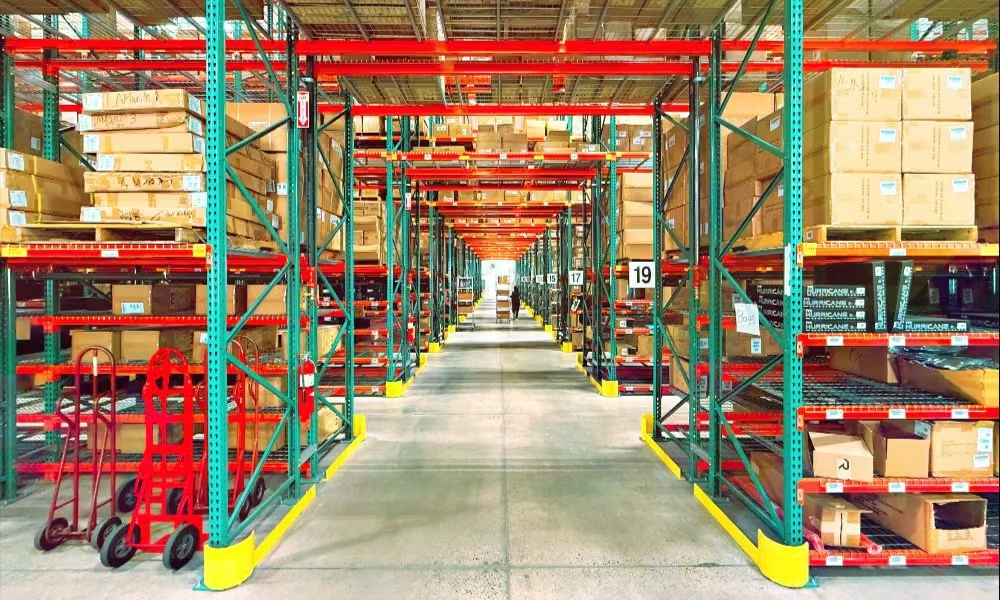
For HVAC, steel, ducting and installation businesses, classic ecommerce often does not fit neatly, and that is fine. Much of the work is quoted, not bought off a shelf. The stronger model is usually a clear online catalogue of what you offer, with set prices on standard parts and consumables where it makes sense, and an enquiry path for anything custom.
Marketplaces rarely suit bespoke industrial work, because the buyer needs to talk through specifications before committing. Here your own site wins easily. Detailed product and specification pages, paired with an easy way to request a quote, will out-perform a marketplace listing every time for that kind of customer.
A simple next step
Before choosing a platform, get honest about your goal. If you mainly need reach and want to test demand quickly, start on a marketplace and accept the commission as the price of speed. If you want to build something you own, with margin and repeat custom, invest in your own store and in being found.
If you would like help mapping which route fits your products, and what an online store would realistically cost and earn for your business, get in touch and we can work through it together.